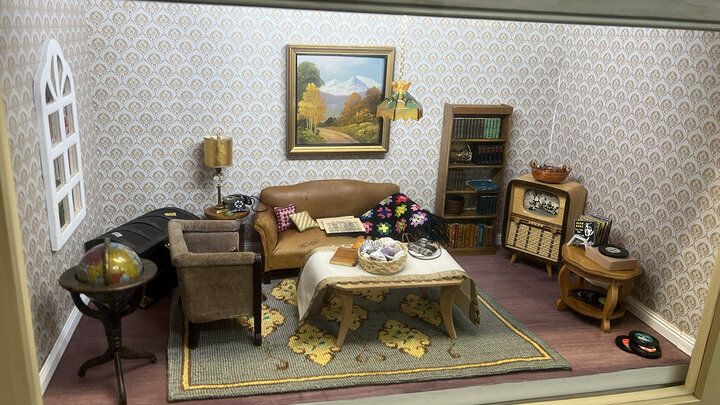
When University of Nebraska–Lincoln (UNL) students traveled to Japan this spring, they did far more than conduct research abroad. They became international museum collaborators, working side-by-side with students from Saitama University to curate and install an exhibition of American quilts that will continue traveling to museums and galleries across Japan long after they returned home.
The May program marked the inaugural U.S.-to-Japan phase of "Stitching Culture: U.S.-Japan Quilt Exhibit Collaborative," an innovative partnership between the School of Global Integrative Studies (SGIS), the International Quilt Museum (IQM), and Saitama University that combines museum studies, cultural exchange, and hands-on exhibition development.
Building on four years of successful exchanges that brought Saitama University students to Nebraska, the program now operates as a fully reciprocal partnership. Students from both universities learn together in each country, gaining practical museum experience while exploring how material culture fosters cross-cultural understanding and international collaboration.
"This year's program allowed us to establish the U.S.-to-Japan portion of the Stitching Culture partnership while giving students from both universities the opportunity to collaborate on every stage of creating a museum exhibition," Marin Hanson, Curator of International Collections at the International Quilt Museum, said. "The experience encouraged students to learn from one another while introducing Japanese audiences to American quilt traditions."
Bringing Nebraska Quilts to Japan
One of the program's most distinctive features was transporting quilts from the International Quilt Museum's Education Collection to Japan.
Unlike the museum's permanent collection, the Education Collection is designed for teaching and outreach, allowing students to work directly with historic textiles while learning professional museum practices.
Hanson selected a collection of nineteenth- and twentieth-century crib quilts that students examined, interpreted, and ultimately transformed into the exhibition "Childhood Stitched in Fabric: American Quilts Inspired by Everyday Life."
Working in mixed teams, UNL and Saitama University students researched the quilts, developed exhibition themes, wrote bilingual English and Japanese labels, and installed the exhibition inside the university's gallery space.
For Chloe Charbonneau, an undergraduate anthropology major who had already been working at the IQM, the opportunity offered a chance to expand both her professional experience and her understanding of museum work on an international stage.
"I had been working at the IQM for a semester and really enjoyed it," Charbonneau said. "When I got the email about Japan, I knew it was something that would give me more experience in the field and allow me to grow more."
Graduate student Alexis Pappas entered the program with a different perspective. Already engaged in quilt research and familiar with Hanson's work, she viewed the experience as an opportunity to combine international travel with textile scholarship.
"I'd never been to Japan, and because of its rich textile history it had long been at the top of my travel list," Pappas said. "I was also excited that the trip was being led by Marin Hanson. I'd worked with her before, knew she would put together an outstanding experience, and would happily travel with her anywhere."
Although the exhibition timeline lasted only two weeks, students quickly learned to navigate both museum practice and intercultural collaboration.
"The students did a brilliant job helping one another understand the many contexts in which American quilts exist," Hanson said. "They also worked together to make sure the bilingual interpretation clearly communicated those stories to visitors."
Learning Beyond the Classroom
While students gained experience in exhibition design and collections interpretation, faculty said the greatest lessons came from working across cultures.
Cross-cultural learning extended well beyond the classroom as students shared meals, visited museums together, participated in craft workshops, and explored Japan outside scheduled activities.
"It gave students daily opportunities to learn about one another's cultures while developing communication skills that simply can't be replicated in a traditional classroom," said Nao Nomura, Associate Professor of Historical Studies at Saitama University, who co-led the program.
Pappas was immediately struck by the rhythm of everyday life in Japan.
"I was struck by how clean, organized, and efficient everything was," she said. "Despite being in one of the world's largest cities, Tokyo felt remarkably calm."
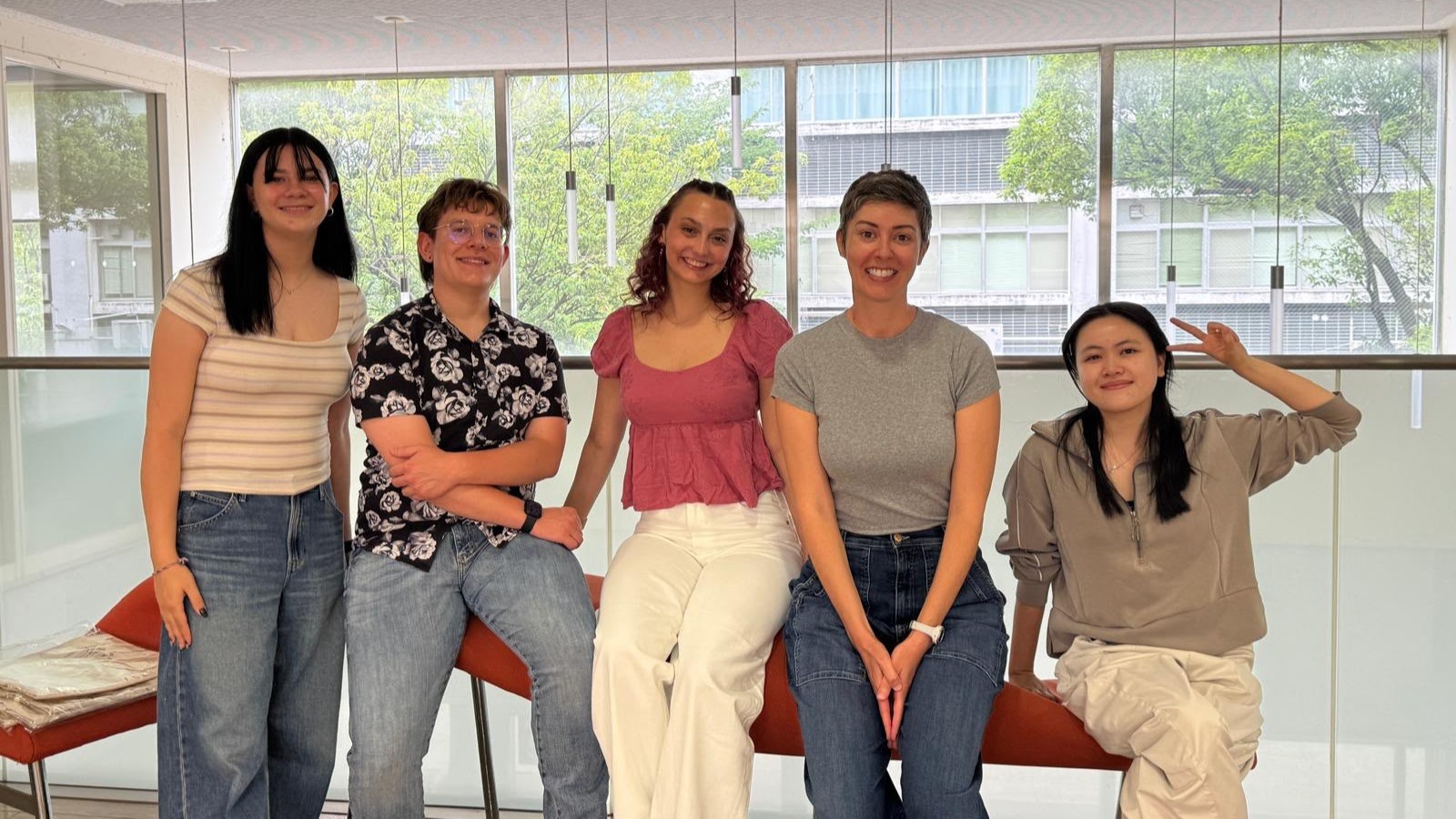
For Charbonneau, whose working group included students from Japan, Ukraine, and China, many of the most meaningful conversations emerged from the quilts themselves.
"One piece that really stood out was Rail Fence," she said. "We started talking about what fences represented in our childhoods. For me, they reminded me of climbing over the fence around my backyard to play with friends. For the Ukrainian students, fences represented protection and the security of home. It was fascinating how the same object could carry such different meanings."
The collaborative nature of the exhibition also gave students a deeper appreciation for museum practice.
"I helped the Japanese students write exhibit labels and handle the quilts," Charbonneau said. "Collaborating with the students was incredibly rewarding because it helped me better understand how museum design works through collaboration."
Students also discovered that museum work often requires creativity and flexibility.
Because the university gallery lacked many of the specialized exhibition materials typically available at professional museums, students and faculty worked together to devise practical solutions using locally available supplies while maintaining professional museum standards.
The collaborative problem-solving became another valuable lesson in adapting museum practices to different cultural and institutional settings.
For Pappas, the program also provided an opportunity to pursue independent research on a quilt housed in the museum's collection. Visiting libraries, archives, and museums throughout Japan gave her firsthand experience navigating international research systems.
"Every archive or library seemed to have a different permission process," she said. "I had to obtain special access to use the Saitama University library, register for the National Diet Library, and get permission to visit the Oya Soichi Library. In some cases it simply wasn't possible to access the resources I had hoped to see. Japanese red tape is real."
A Partnership That Continues to Grow
The impact of the program extended well beyond the exhibition itself.
Faculty watched students who were initially hesitant—particularly those working in their second language—grow increasingly confident as the project progressed.
"At the beginning, many Saitama University students were understandably quiet because it was their first time taking a class conducted in English," Nomura said. "By the time we were installing the exhibition, they had become confident, creative, and fully engaged."
For UNL students, navigating language differences became part of the learning experience.
"The language gap was definitely the biggest challenge," Charbonneau said. "Sometimes conversations shifted between English and Japanese, and I felt like I was missing pieces. But it also taught us to communicate in different ways and be patient with one another."
The exchange also strengthened relationships first established during previous Nebraska visits. Students who had met in earlier exchanges reunited throughout the visit, spending weekends together and celebrating the exhibition opening as friends rather than strangers.
One of Charbonneau's favorite memories came after the exhibition officially opened.
"Everyone went out to dinner together afterward," she recalled. "We pushed five tables together at a little Italian restaurant, and it was one of those moments where I realized we had formed genuine friendships."

Pappas remembers equally unexpected moments.
"Unexpectedly spotting a Nebraska T-shirt hanging for sale on a street in Tokyo was unforgettable," she said. "I also loved visiting museums throughout the city, especially the Hanae Mori exhibition at the National Art Center, Tokyo, and simply spending time with the rest of our group."
For some participants, the experience has already influenced future academic and career goals.
"One student who visited Nebraska last year is now working toward returning to the United States to study," Nomura said. "That shows how deeply these experiences can shape students' futures."
Charbonneau says the experience also broadened her own professional aspirations.
"My goal is still to become a museum conservator," she said. "But after this trip, I'm much more open to working abroad. That was never something I had considered before."
Looking back, Pappas encourages other students to take advantage of the opportunity.
"Go!" she said. "It's a wonderful opportunity and one I'd recommend without hesitation. It's a very safe way to explore another country, the trip length is ideal, and there's a great balance between structured activities and free time to pursue your own interests."
From Campus Project to International Exhibition
Unlike many student exhibitions that conclude at the end of a semester, "Childhood Stitched in Fabric" continues to reach new audiences.
Following its debut at Saitama University, the exhibition traveled to Janus Art Gallery in Tokyo and will continue to Nara Women's University this fall, allowing visitors across Japan to experience American quilt traditions through an exhibition created by students.
The traveling exhibition also expands the international visibility of the International Quilt Museum, SGIS, and UNL while laying the foundation for future collaborations with museums and universities in both Japan and the United States.
"This year's success has already created momentum for future exchanges," Nomura said. "Several Saitama University students who participated in the program have expressed interest in coming to UNL, continuing the cycle of reciprocal learning."
For Hanson, the program demonstrates how museum education can transcend national boundaries.
"Preserving cultural heritage is a global endeavor," she said. "By learning how museums and cultural institutions operate in different countries, students develop broader perspectives that will serve them throughout their professional careers."
As "Stitching Culture" continues to expand, the partnership offers students something few academic programs can provide: the opportunity to create exhibitions for an international audience, conduct research across cultures, develop lasting international friendships, and contribute to museum projects whose impact extends far beyond the classroom.